
What Is Apple Ads Max Conversions? A Complete Guide to How It Works and Operational Strategies
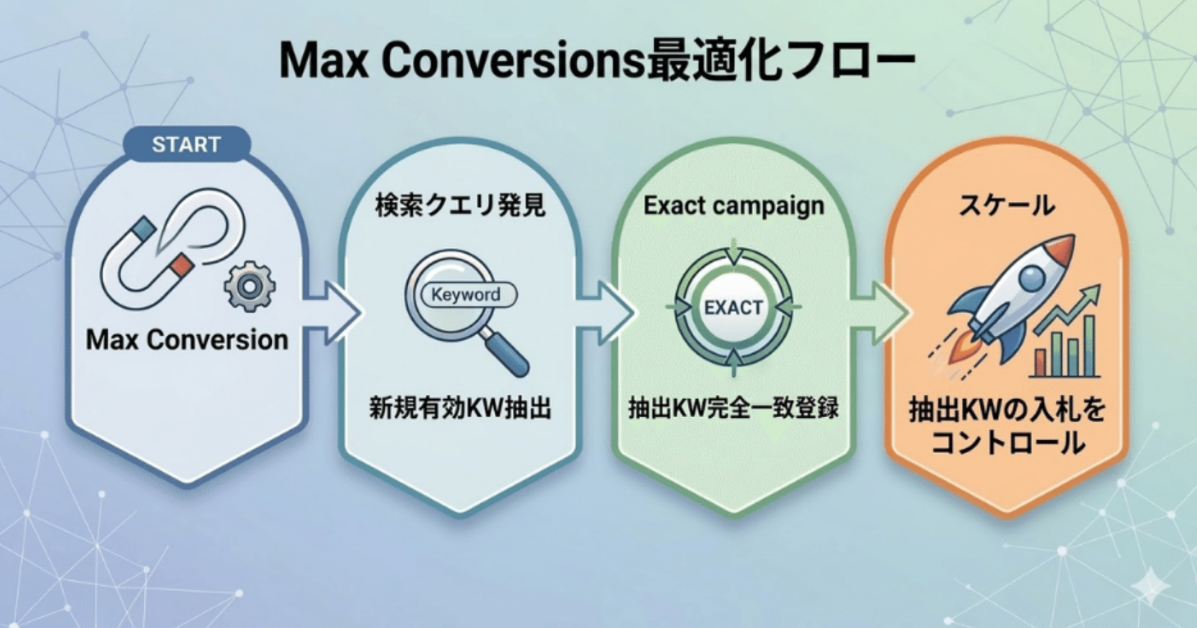
Apple Ads, Apple’s app advertising platform, has been moving increasingly toward automated ad operations in recent years. One of the new features introduced as part of this shift is Max Conversions. Max Conversions was officially released on February 26, 2026, and became available as a bid strategy for search results campaigns within Apple Ads.
This article provides a detailed explanation of:
Apple Ads Max Conversions is an automated bidding campaign designed to maximize tap-through installs, or conversions, based on a configured Target CPA. Apple’s intelligent automation automatically adjusts bidding and ad delivery.
Note: CPA stands for Cost per Acquisition, meaning cost per app download. Be careful not to confuse this with Cost per Action.
Its main features are:
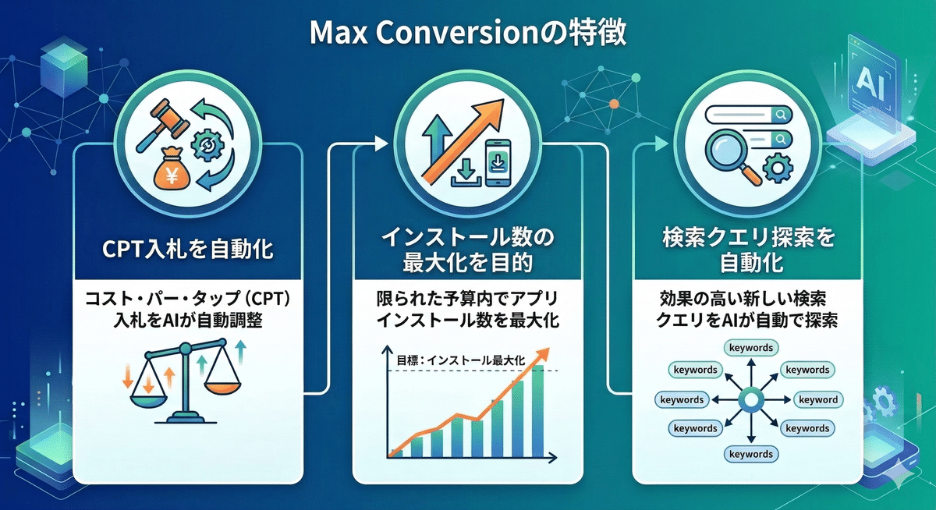
In traditional Apple Ads campaigns, advertisers needed to set bid prices, or CPT bids, for each keyword. With Max Conversions, however, the following elements are automatically adjusted by the algorithm:
This means that AI-based automated bidding has effectively been introduced to Apple Ads. The mechanism is similar to install-maximization bidding models used in platforms such as Google Ads.
Traditional Apple Ads campaigns were fundamentally based on CPT bidding, or Cost Per Tap. Advertisers had to manually manage tasks such as:
Max Conversions significantly changes this approach.
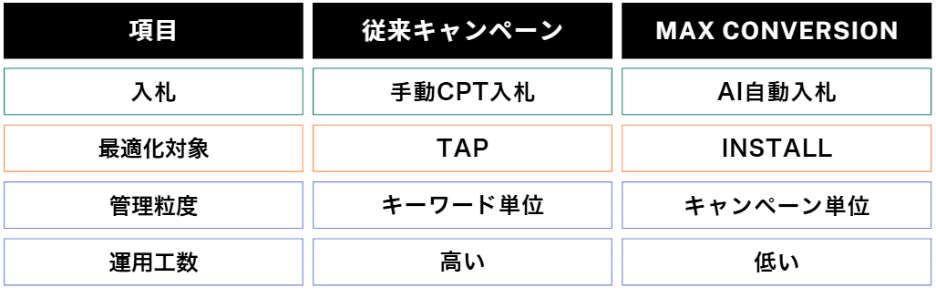
In short, Apple Ads optimization is evolving from tap optimization to install optimization.
In Max Conversions, Apple’s machine learning automatically sets the optimal bid for each search query based on real-time signals. According to Apple’s official explanation, Maximize Conversions campaigns use AI-based automated bidding, or an auto-bidder, to optimize ad delivery in a way that maximizes installs based on the advertiser’s Target CPA. The algorithm adjusts bids according to each search query while optimizing the campaign overall so that the average CPA approaches the Target CPA.
When a Max Conversions campaign is created, Apple Ads automatically generates an Automated Ad Group. This functions as a search query discovery engine, and the following elements are all automated within this ad group:
Advertisers can also optionally add manually managed ad groups. In these ad groups, the following settings can be configured:
However, CPT bids cannot be set at the individual keyword level.
Because Max Conversions optimizes bidding through a machine learning algorithm, it requires a certain amount of ad delivery data and conversion data. For this type of machine learning-based bidding, sufficient ad volume and conversion data are needed for the algorithm to optimize effectively.
Therefore, when operating Max Conversions, it is important to:
Apple’s official guidance also recommends setting a budget that can generate at least five conversions per day for Maximize Conversions campaigns. Max Conversions also has a learning period. When evaluating campaign performance, it is recommended to run the campaign for at least around two weeks.
Max Conversions offers four main benefits:
Because bidding is automated in Max Conversions, some of the tasks required in traditional Apple Ads operations can be reduced. For example, traditional Apple Ads operations required tasks such as:
With Max Conversions, these bidding management tasks are automated by the algorithm, allowing campaign managers to focus more on campaign design and App Store optimization rather than bid adjustments.
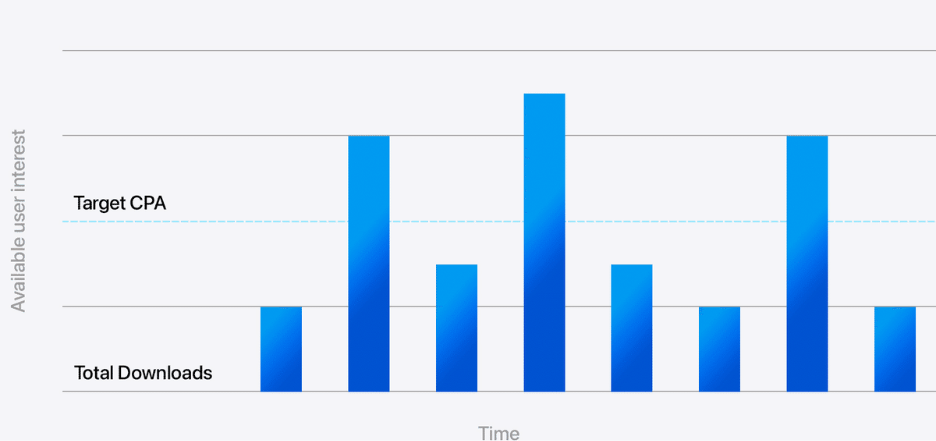
In Max Conversions, the algorithm automatically adjusts bids while evaluating the value of each search query based on the Target CPA. For Manage Bids campaigns that currently use cost-per-acquisition caps, the cap is applied each time a search term matches an ad. As a result, even search terms that are likely to lead to installs may have bids limited by the configured cap, which can reduce opportunities for ad impressions.
With Maximize Conversions, however, the auto-bidder adjusts the optimal bid for each search query based on the target cost-per-acquisition set at the campaign level. It can bid more actively on search queries considered more valuable and lower on others, helping maximize tap-through installs while aiming to meet the target cost-per-acquisition on average.
Because cost-per-acquisition caps are expected to become unavailable in the future, now is a good time for campaigns currently using them to consider transitioning to Maximize Conversions. During the transition, it is important to set an appropriate target cost-per-acquisition for each campaign. This can help expand delivery opportunities across search queries that are more likely to drive results, while the daily budget helps manage overall spend. For example:
Through this process, the campaign is optimized so that the average CPA approaches the Target CPA overall. As a result, there may be days when CPA temporarily exceeds the acceptable target, but the algorithm is designed to bring overall CPA closer to the target over time. This mechanism can expand ad impression opportunities compared with traditional bid-cap-based operations.
One key feature of Maximize Conversions is that it combines Search Match with automated bidding, making it easier to identify search queries that are likely to lead to installs. Rather than relying only on keywords set in advance by the advertiser, it can help broaden delivery opportunities across relevant search queries while aiming to generate more tap-through installs.
When a Maximize Conversions campaign is created, an Automated Ad Group is created. In this Automated Ad Group, Search Match is turned on and required. The audience setting is also set to Reach All Eligible Users, making it easier to cover a wide range of relevant keywords.
However, this does not mean that Maximize Conversions is entirely automated with no ability to adjust keywords. Advertisers can create an additional ad group as needed, where they can adjust audience settings, use a custom ad, and select or pause specific keywords. When specific keywords are selected, the auto-bidder matches ads to search queries that include those keywords. However, in Maximize Conversions campaigns, keyword-level bids cannot be added or managed. The structure allows advertisers to adjust keyword direction while leaving the bidding itself to the auto-bidder. As a result, ads may be shown for search queries such as:
This makes it possible for previously unconfigured search queries to appear in search term reports, creating opportunities to discover new keywords.
For example, even when a Japanese marketer is managing ad operations, there may be cases where ads are delivered in languages the marketer does not personally understand, such as:
In such cases, Max Conversions can automatically expand search queries and deliver ads to relevant searches through the algorithm. If effective search queries are discovered, those keywords can then be added as exact match keywords, allowing advertisers to control delivery more precisely.
In other words, by using Max Conversions as a discovery campaign, advertisers can broaden keyword discovery and campaign operations for overseas markets. As a result, Max Conversions can help identify new user segments in countries and regions that were previously difficult to reach, which can be considered one of its advantages.
There are several points to keep in mind when using Max Conversions. Although automated bidding can improve operational efficiency, it is important to understand the characteristics of the algorithm before using it.
At present, Max Conversions optimizes only for installs. Therefore, post-install metrics such as the following are not included in the algorithm’s optimization target:
In other words, the algorithm optimizes based on the number of installs, not user quality. To properly evaluate ad performance, post-install analysis using an MMP is important.
Because Max Conversions optimizes bidding using a machine learning algorithm, it has a learning period. Apple’s official guidance recommends evaluating Maximize Conversions campaign performance after running the campaign for at least around two weeks.
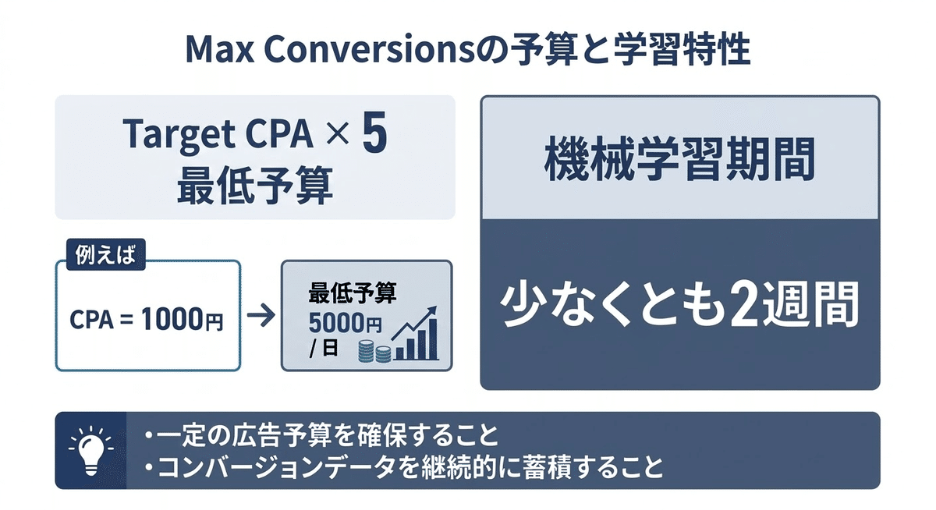
Therefore, daily performance during the learning period may not match the Target CPA exactly. However, the algorithm optimizes the campaign so that the average CPA approaches the Target CPA overall.
Max Conversions does not allow bid adjustments at the individual keyword level. Therefore, it is not suitable for operations that require:
For example, if you want to strengthen bids for brand keywords or specific high-volume keywords to aim for higher ad placement, or if you need to strictly control CPA for specific keywords, traditional exact match campaigns are more appropriate.
Because Max Conversions broadly explores search queries, ads may be delivered to searches with weak intent or low relevance. Therefore, campaign management still requires basic controls such as:
Max Conversions should not be used as a complete replacement for existing campaigns. Rather, it is more effective when used as a keyword discovery campaign. The recommended operational structure is as follows.
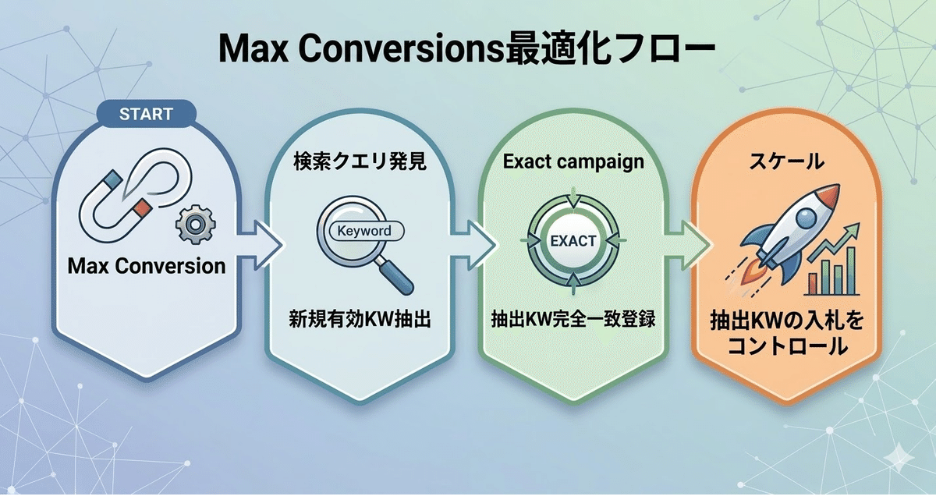
First, use Max Conversions to discover new search queries and related keywords. Since the algorithm predicts the install probability of each search query and delivers ads to related long-tail and similar searches, it can surface search queries that are difficult to find through manual operations.
In practice, advertisers should regularly review the search term reports from Max Conversions campaigns and extract high-performing search queries. Keywords with stable metrics such as CPA, CVR, and install volume can then be transferred to exact match campaigns, where delivery can be scaled while controlling bids. This approach aligns with the Discovery campaign structure described on Apple Ads’ official pages, with Max Conversions being used to fulfill that discovery role.
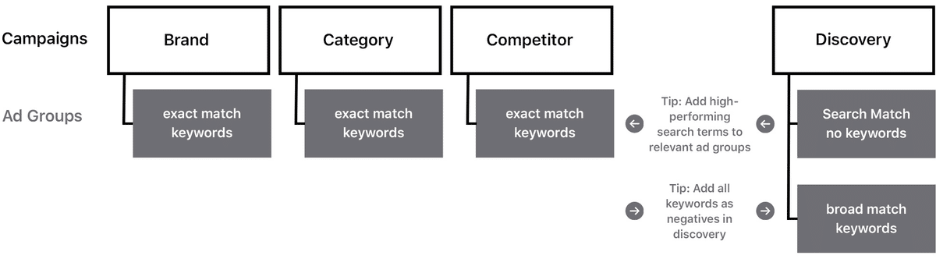
In this way, advertisers can divide roles as follows:
By separating these roles, advertisers can balance discovery and scale. This approach can also be described as using Max Conversions as a keyword discovery engine. In traditional Apple Ads operations, Search Match was commonly used to discover related searches. However, because Max Conversions optimizes bidding and delivery at the same time, it may be able to explore a wider range of search queries than Search Match. Maximize Conversions builds on Search Match by combining it with AI-powered bidding, enabling broader and more efficient search query discovery.
The introduction of Max Conversions is significantly changing how Apple Ads campaign management should be approached. Previously, Apple Ads operations focused heavily on adjusting CPT bids by keyword. With Max Conversions, however, much of the bidding process is automated by the algorithm.
As a result, ad performance becomes more dependent on the CVR, or conversion rate, of the App Store product page, rather than bid adjustments. Even with the same CPC, a higher CVR leads to a lower CPA. In other words, improving the App Store page’s CVR is becoming more important than ever for improving ad performance. The main elements that influence CVR include:
By optimizing these store elements, advertisers can improve the install rate from ads, which ultimately leads to better Apple Ads performance.
In this way, the introduction of Max Conversions is shifting Apple Ads operations away from bid-adjustment-centered management and toward strategic planning that includes optimization of the overall App Store experience. Therefore, Max Conversions should not be seen simply as a feature that fully automates ad operations. Rather, it can be understood as a feature that may shift the focus of ad operations from bid management to store strategy.
Apple Ads Max Conversions is not merely an automated bidding feature. It represents a structural change in Apple Ads campaign management. Until now, Apple Ads operations have mainly centered on bid adjustments. With the introduction of Max Conversions, ad operations are gradually shifting from a bidding game to a CVR game.
Going forward, a store-driven advertising strategy that integrates the following elements will become increasingly important:
What Is Apple Ads Max Conversions? A Complete Guide to How It Works and Operational Strategies
ReadApple Ads Tips for Japanese Gaming Companies Expanding to the US and Global Markets
ReadLearn more about the role of intent in telling you where your audience is in their decision journey, how warm they are, and how close they are to converting.
ReadExperience the future of app marketing with V.O.X.
Where visibility meets opportunity.
%20(2).png)

.png)
.png)
.png)